
PAGCOR’s licensed-site checker app: what is confirmed for the December 2026 launch

Short answer — PAGCOR said on 19 October 2026 that it is targeting December 2026 for a mobile app that lets players check whether an online gaming platform is licensed. The PAGCOR board approved the app on 8 October, with the Development Bank of the Philippines Data Center, Inc. (DCI) to build, host and run it at no cost to PAGCOR under a five-year arrangement. Before full rollout, DCI must pass a six-month proof-of-concept assessment. The plan was first announced on 24 August, when PAGCOR’s chairman told a House budget hearing that around 50% of online gaming sites accessed in the Philippines are illegal. Until the app arrives, the existing PAGCOR Guarantee website remains the official check.
This guide sets out what PAGCOR has actually said, the timeline in days, the open question in that timeline, and a step-by-step way to verify a site today.
What did PAGCOR announce, and when?
The story has two official PAGCOR releases. The first, “PAGCOR to launch app to protect online gaming players”, dated 25 August 2026, reports that Chairman and CEO Alejandro H. Tengco told the House Committee on Appropriations on 24 August that an app would be launched “before the end of the year”. He gave it two aims: to curb illegal online gambling and to make sure players use only licensed, regulated platforms. Tengco is quoted saying: “Around 50 percent of online gaming sites accessed in the Philippines are illegal.”
The second, “PAGCOR targets December launch of app vs. illegal online gambling”, dated 19 October 2026, gives the governance details. We read both on 22 October 2026.
| Date | What happened | Source |
|---|---|---|
| 2025 | PAGCOR launched the PAGCOR Guarantee verification page | PAGCOR, 25 Aug 2026 |
| 24 August 2026 | Chairman Tengco announces the app at the House budget hearing | PAGCOR, 25 Aug 2026 |
| 8 October 2026 | PAGCOR board approves development and the proposed DCI partnership | PAGCOR, 19 Oct 2026 |
| 19 October 2026 | PAGCOR announces the December 2026 target | PAGCOR, 19 Oct 2026 |
| December 2026 | Target launch | PAGCOR, 19 Oct 2026 |
Who builds the app, and on what terms?
According to the 19 October release, DCI “will handle the app’s development, hosting, operation, maintenance, and technical support at no cost to PAGCOR”. The arrangement is “subject to applicable laws and regulations” and runs for five years, renewable by mutual written agreement. Before full-scale implementation, DCI must present a proof of concept for a minimum viable product. PAGCOR describes a “six-month assessment” of the proposed features, system architecture, security controls and overall feasibility, and says it may end the arrangement if DCI fails to fix deficiencies within a reasonable time.
The release also says the partnership must comply with data privacy, cybersecurity and information-security laws, including the Data Privacy Act of 2012, with data sharing covered in the terms or a separate agreement. PAGCOR adds that it is coordinating with the Department of Information and Communications Technology, the National Telecommunications Commission and the Cybercrime Investigation and Coordination Center against illegal operators.
Is December realistic? The timeline in days
Counting from the board approval on 8 October 2026, our calculation gives the following intervals: 11 days to the public announcement, 54 days to the start of December and 84 days to the end of December. A six-month assessment starting on the approval date would run to about 8 April 2027, roughly 182 days.
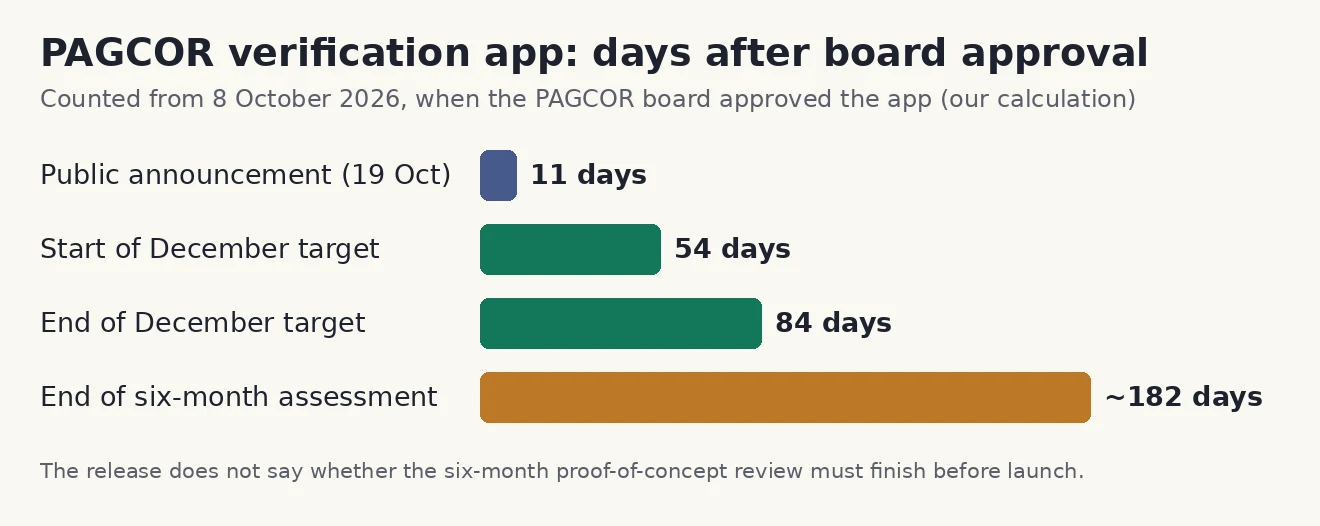
The release does not say when the six-month clock starts, or whether the December launch is the minimum viable product being assessed or the full-scale app that follows it. If the assessment must finish first, a full rollout would fall after December. A more consistent reading is that December refers to a first version that is then evaluated for six months, but that is our interpretation, not PAGCOR’s statement. Expect the first release to have fewer features than the final platform.
How big is the problem the app targets?
Tengco’s figure of “around 50 percent” refers to online gaming sites accessed in the Philippines, not to money wagered. PAGCOR’s own revenue figures show why the regulator cares about keeping players on licensed platforms. In its 16 April 2026 release, PAGCOR reported that the e-games and online segment generated ₱201.12 billion of gross gaming revenue in 2025, 50.77% of the industry total of ₱396.14 billion.
A cautious illustration of our own: if spending on illegal sites were even one-tenth of the licensed online segment, that would be about ₱20 billion a year outside the regulated system. This is a hypothetical ratio to show scale, not an estimate; PAGCOR has not published the value of illegal play.
For the individual player, the point Tengco made at the hearing is practical rather than statistical. Translated from Filipino, his remark was that as long as the site you play on is licensed, there is a resolution process if something goes wrong. On an unlicensed site there is no regulator to complain to.
How can you check a site before the app arrives?
PAGCOR’s August release points to the PAGCOR Guarantee page, launched in 2025 as an online verification facility. When we opened it on 22 October 2026, it listed PAGCOR-authorised online gaming websites by category, including electronic casino games, electronic bingo, sports betting, specialty games, online poker, licensed casinos, traditional bingo and numeric games.
- Find the exact brand on the PAGCOR Guarantee page. Names that are merely similar do not count; copycat sites often borrow a real brand’s look.
- Check the web address you are actually on. Compare the domain with the brand name on the listing, letter by letter, and be wary of extra words or numbers added to a familiar name.
- Be wary of payment requests to personal accounts. Licensed operators are subject to regulatory requirements; requests to send money to an individual’s e-wallet are a warning sign.
- Keep records. Screenshots of deposits and terms make it easier to use a licensed operator’s dispute process.
- Re-check after updates. When the app launches, compare its result with the website for the first few weeks.
Remember that only adults aged 21 and over may play, and licensing does not make gambling risk-free.
What a licence check cannot tell you
A verification tool answers one question: is this platform authorised? It is an important question, but not the only one. A licensed site can still be the wrong choice for you if its limits, bonus terms or game mix push you to play longer than you planned. Equally, a “licensed” badge pasted on a page is not proof; only the regulator’s own list counts.
Three things are worth checking alongside the licence. First, the site’s responsible-gaming tools: deposit limits, session reminders and the option to take a break or exclude yourself. Second, the withdrawal terms, especially minimum amounts and processing times, which you should read before your first deposit, not after a win. Third, the support channel, because PAGCOR’s point about dispute resolution only helps if you can document your issue with the operator first.
A simple rule of thumb from our side: if any of these three is hard to find, treat that as information about the operator, whatever the licence status. The new app, once live, should make the first check faster; the other three remain your job.
What is still unconfirmed?
- The app’s name, platforms (Android, iOS or both) and exact launch date within December.
- Its feature list, for example whether it will check web addresses, apps, payment accounts or all three.
- How the six-month assessment fits with the December target.
- Whether the app will let players report illegal sites directly.
We will not guess at these. Watch PAGCOR’s headlines page for the launch notice.
Sources (checked 22 October 2026): PAGCOR, 19 October 2026; PAGCOR, 25 August 2026; PAGCOR, 16 April 2026; PAGCOR Guarantee. Day counts and the illustrative ratio are our own calculation.