
Corrected lottery results: a revised record is not another draw
A corrected result can replace an earlier record for the same draw without adding a draw to your history. Keep the draw identity separate from the version of the information published about it. Otherwise, the original and corrected copies can both enter a spreadsheet and distort its counts.
This guide in the slotvip lottery section uses an invented correction notice. It does not report a real lottery error, official result or redraw.
Keep one event and two record versions
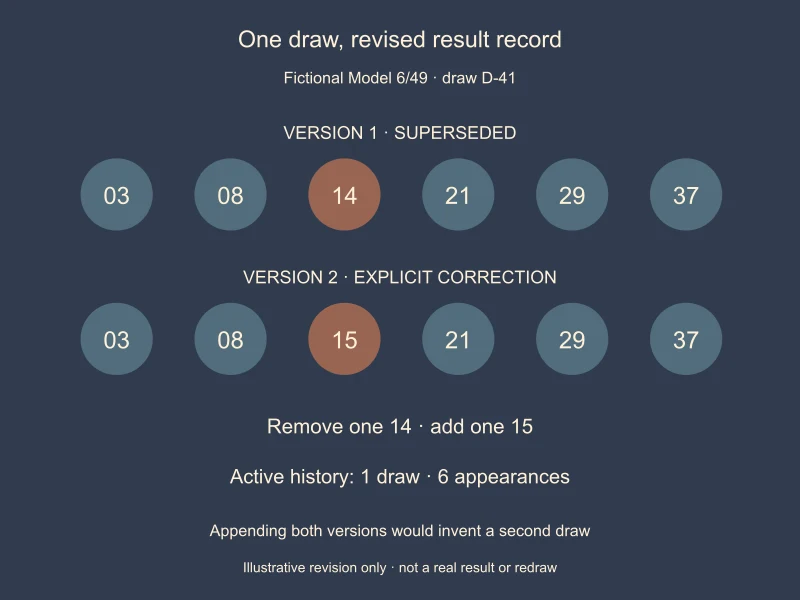
Our fictional six-number product is called Model 6/49, and the event is draw D-41. A source first publishes version 1 with 03, 08, 14, 21, 29 and 37. It later explicitly identifies version 2 as a correction to that same D-41 record: 03, 08, 15, 21, 29 and 37.
The correction says that 15 replaces 14. The product, draw ID and original draw date remain the same. These details are assumptions of our example, not a claim about a Philippine lottery’s correction policy.
| Record | Product and event | Numbers | Role in the example |
|---|---|---|---|
| Version 1 | Model 6/49 · D-41 | 03, 08, 14, 21, 29, 37 | Superseded result record |
| Version 2 | Model 6/49 · D-41 | 03, 08, 15, 21, 29, 37 | Explicit correction to version 1 |
There are two documents describing one draw. Preserve both as evidence of what was published, but use only the stated corrected version in the active result table once the correction’s source and identity are established.
Update the counts by replacing the old contribution
Suppose the active worksheet already contains D-41 version 1. Replacing it with version 2 removes one appearance of 14 and adds one appearance of 15. The counts for 03, 08, 21, 29 and 37 do not change. The draw count remains one and the total number of recorded ball appearances remains six.
Appending version 2 as another draw would produce two draw rows and twelve ball appearances. The five unchanged numbers would each be counted twice. It would also leave 14 in the active history even though the example correction explicitly replaced it.
For a longer archive, this operation still concerns just D-41. Keep every other draw intact. Recomputing the frequency table from the corrected active rows is a straightforward cross-check against the remove-old/add-new calculation. The resulting frequencies describe that archive; they do not predict a future draw.
A later page timestamp is not enough
Two different screenshots can disagree for reasons other than an authorized correction. One may show another game, another session, an incomplete result or an unrelated copy. A later upload time alone does not tell you which explanation applies.
Before replacing a result, locate the notice or record that explicitly connects the versions. Record the full source URL, product, draw ID or equivalent event fields, the original draw date, what changed and the time you checked it. Preserve the source’s correction wording rather than making up a revision label from a timestamp.
The existing result-link hostname guide explains the first source check. A correct host is still separate from the correct product, event and record version. In our example, all three must agree before version 2 replaces version 1.
A redraw needs its own event information
A revised publication and a newly conducted draw are different claims. If a source announces a redraw, preserve its actual event identity, relationship to the earlier draw and the applicable notice. Do not infer a redraw merely because one number changed on a webpage.
Conversely, do not merge two genuinely different draw events just because their results happen to be identical. The key is the event information supplied by the source, not whether the number lists are equal. Our D-41 correction remains one event because that relationship was explicitly declared.
Leave an unresolved conflict visible
If the two records have the same apparent identity but no verified correction relationship, mark the draw as disputed or unresolved in your own worksheet. Keep both source copies and avoid silently adding both as confirmed draws. There is no need to choose a version just to fill every cell.
A result-history correction also does not establish a prize payment, ticket validity or a claim deadline. Those questions require the relevant rules and confirmed claim records. The simple worksheet here updates result information only.
W3C’s PROV-O revision definition treats a revision as a revised version derived from an original record. That is a useful general information-model distinction; it is not a lottery regulation or a ruling on any real result.
The two versions, one-number replacement and six-versus-twelve count check were verified on 10 October 2026. All numbers and notices are fictional. No live result dispute, ticket purchase or claim was investigated for this guide.