
Base win, feature win and total: which should be combined?
Three different counters may show the same round. Compare the range of each amount before adding to avoid counting the same award twice.

Add only the separately confirmed components. Do not add back the total that already includes them. If the base win is 18 credits and the full feature win is 46, the combined award is 64. Another “Total 64” display may sum up two values, not a third award.
This is a more useful question than “which number is bigger?”: What exactly does the number cover, and is it final? We will use our own receipt model to compare component, subtotal and total. This is not a screenshot of a live session or paytable of a specific game.
Entry into the feature is not the final award
Entry conditions, progress and payment are different questions. For example, in official overview of the original Wolf Gold, six or more money symbols in the base game trigger the Money Respin. After the respins are exhausted, then the values of the visible money symbols are given. There is also a separate condition related to filling all 15 positions and Mega Jackpot. This shows why “feature entered” and “award determined” need to be separated.
That example is of limited use: timing and different rule conditions only. It does not verify the contents of an operator’s account history, and we do not transfer the mechanics to Ultimate or another variant. No assumption is made that this game is available in a slotvip destination. The current help of the exact title and version must be matched with the own record.
For wider entry, eligibility and award differences, there is a separate guide to special-feature rules. The worksheet below focuses on accounting after determining the range of amounts.
Own receipt: three labels, two components
Assume a completed round with ID R-204. The unit is equal credits. In this fictional record, the field definitions explicitly state that the base award is separate from the feature award, and that the round total covers both. No extra charges, refunds, fees or separate promotional payments.
| Field | Value | Scope | How to use |
|---|---|---|---|
| Base award | 18 credits | Regular win only | A component |
| Feature award | 46 credits | Full completed feature | Another component |
| Round total | 64 credits | Base + features | Check sum; not a new component |
| Confirmed stake | 10 credits | A single paid action in the model | Separate cost for net calculation |
The correct sum is 18 + 46 = 64 credits. 18 + 46 + 64 = 128 is double counting: first the two components are added and then their sum. The award does not increase because it is shown again on the end screen.
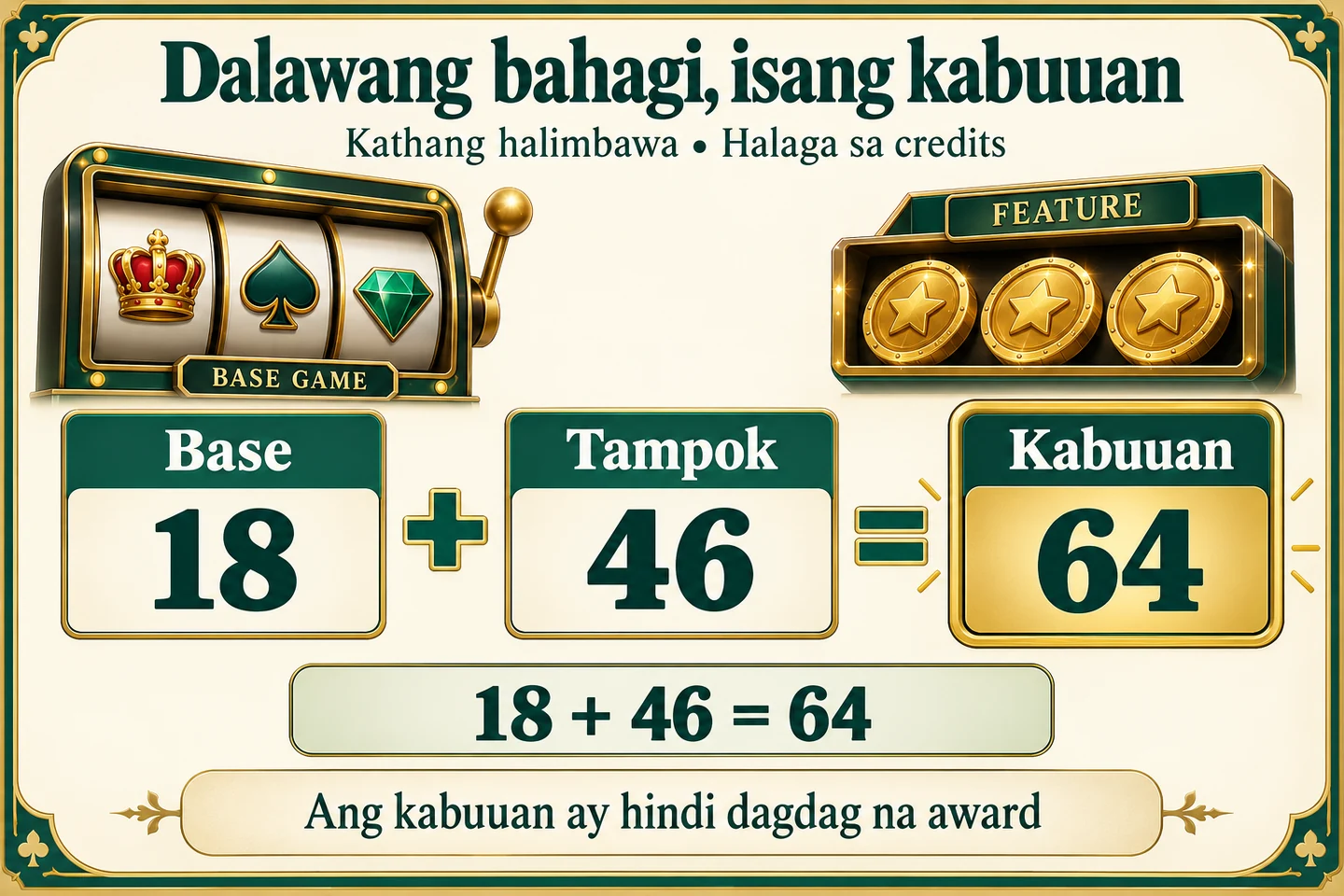
If only the total is clear in the history, record the confirmed total first. No need to invent the breakdown. If there are only components, a computed sum can be generated if it is clear that they do not overlap; mark it as its own calculation so that it is not mistaken for a separate field from the operator.
What if there is a jackpot within the feature total?
Let’s delve deeper into both fictional records. The feature detail says that the 46 credits consist of 16 regular feature credits and 30 jackpot credits. The round total did not change; the explanation of one component just became more detailed.
Before combining the amount, check the stake basis in the fixed-jackpot multiplier example.
There are two equivalent methods: 18 + 46 = 64, or 18 + 16 + 30 = 64. Select a single level of breakdown. 18 + 46 + 30 = 94 is wrong because 30 is already in 46. You can still list the jackpot as a sub-row, but don’t include it back into the sum.
The answer would differ if the actual rule and ledger clearly showed that the jackpot is excluded from the feature figure and credited separately. The size of a banner or the word jackpot alone cannot establish that. Find the definition, transaction reference and settlement status before selecting a formula. The 16 and 30 here are editorial assumptions, not Wolf Gold prize values.
64 is the award, but 54 is the net change in the model
There is a 10-credit stake on the receipt. If the opening balance is 200 and there is no other movement, the ending balance is 200 − 10 + 64 = 254 credits. So the net increase is 54, not 64. The award and net result are different quantities.
Also don’t deduct the stake twice. If the history field is clearly a net change, that is no longer a gross award that will be reduced again. In our receipt, 18, 46 and 64 are clearly gross awards so 10 was deducted separately.
The balance check detects mismatched records. This does not ensure that it is the exact posting order of an operator. When there is a deposit, withdrawal, currency conversion, bonus wallet or pending transaction, a wider ledger is needed before the difference can be explained. Separate those from the game award.
Only visible when “feature triggered”.
If the base 18 is confirmed but the feature is ongoing or pending, the final combined award is not yet known. Write it down base confirmed: 18; feature: pending; final total: unknown. Do not make the unknown zero to make the total appear complete, and do not enter a predicted jackpot amount.
A provisional subtotal of 18 might help, as long as it’s clearly only partial. Upon completion of the feature, match the new record to both the round reference and unit. Re-viewing or refreshing a display is not automatically a new transaction. If the details are conflicting, set aside the evidence and seek clarification from support; no new wager is needed to “test” the accounting.
A worksheet that can be applied to one’s own history
- Identity: exact game/version, round reference and time including time zone.
- Units: credits or currency; do not combine different units without clear conversion.
- Scope: base-only, feature-only, including jackpot, or whole-round total.
- Status: confirmed, ongoing, pending or reversed, according to the record.
- relationship: independent component, included subcomponent, or summary only.
- check: component sum against the final total; then separate stake and balance reconciliation.
If a field is missing, that’s a concrete question to take to support. More clear is “is the jackpot row included in the feature total in R-204?” than “why didn’t the win increase?” Keep account details private; do not send password or OTP.
Frequently asked questions
Do all games have separate base and feature fields?
The guide does not assume that. The total can be given, or a different structure can be used. The worksheet is a way of reading the documented fields, the interface is not guaranteed to be the same.
Does a bigger total mean a higher future chance?
There is no such conclusion in the receipt. Finished record being checked; it has no prediction of the next result or guarantee of income.
Where to start if the question is in a different format?
Back to site homepage to select a format, or to library of guides. If the cost of entering the feature is unclear, read on difference between ordinary spin and optional entry.